21 September 2026
How Apples Are Graded in India: Size, Colour and Quality
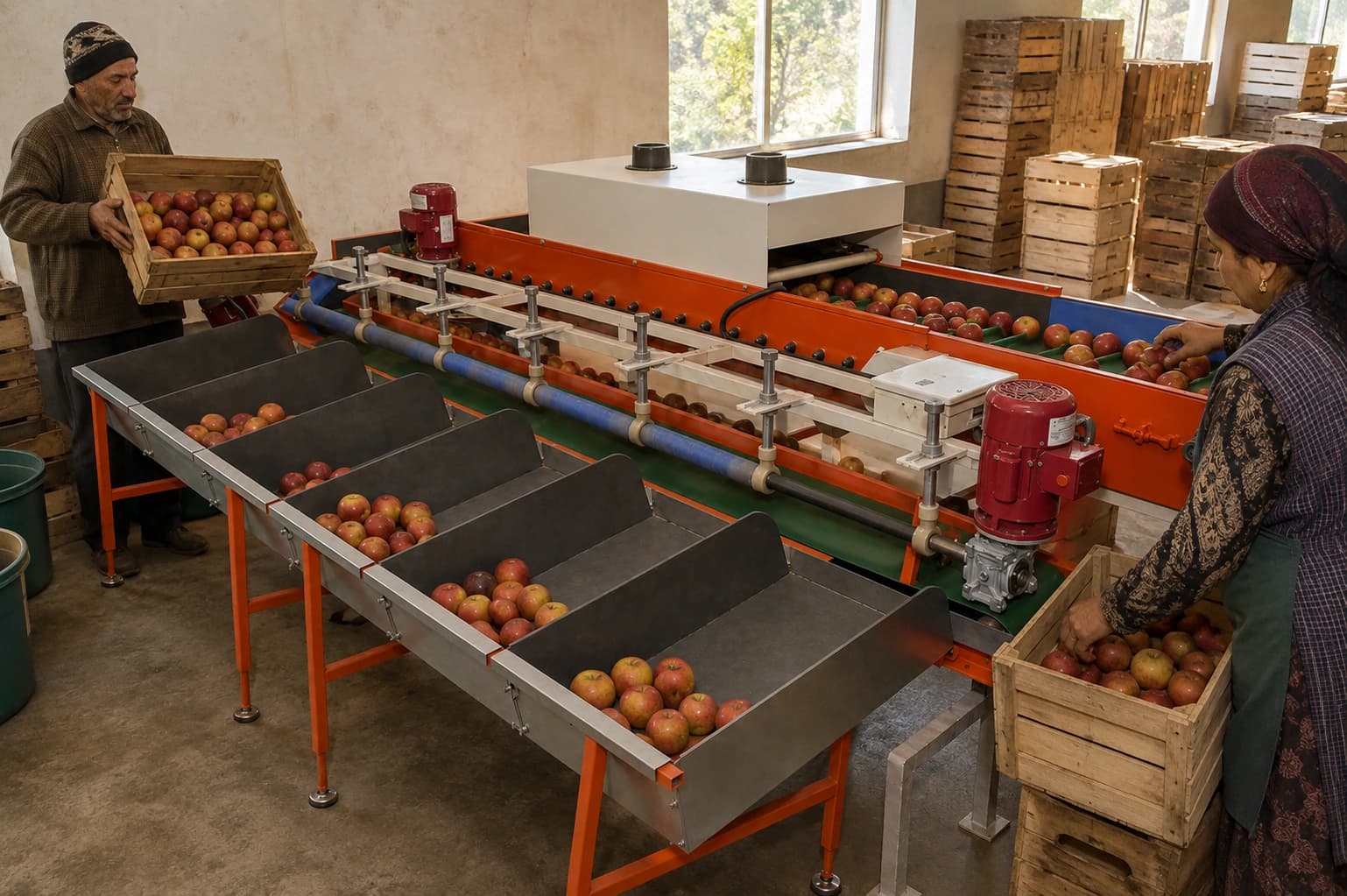
Ask two packhouses how they grade apples and you will often get two slightly different answers. That is because grade is used for three separate things: how big the apple is, how it looks, and how many defects a lot is allowed to carry. Buyers usually specify all three. A machine only handles some of them, so it helps to know which is which.
What an apple grading machine does (apple grading machine kya hai)
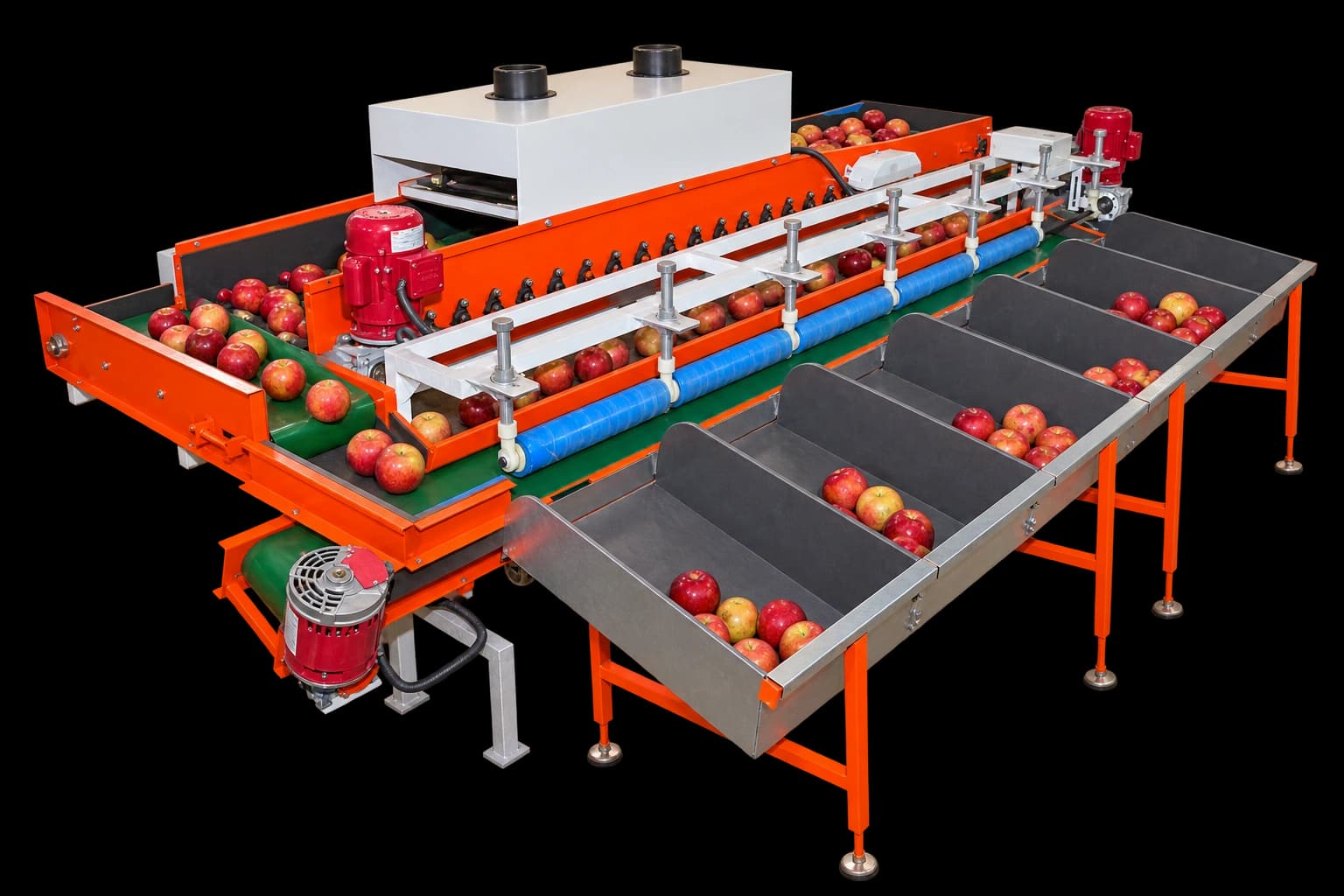
An apple grading machine sorts apples into size groups as they travel along a line. On our machines the apples ride across a roller bed, the roller spacing sets the size cut, and each apple drops into the lane for its size. It does the size job of a hand-sorting crew in one pass. It does not judge colour or spot a blemish, which we come back to below.
Size grades in Himachal and Kashmir
The Small Farmers' Agribusiness Consortium (SFAC) publishes fruit quality specifications for its Kisan Mandi buying. For Himachal apples it lists six size grades: Ex Large above 85 mm, Large 75 to 80 mm, Medium 70 to 75 mm, Small 65 to 70 mm, Ex Small 60 to 65 mm and Pitthoo 50 to 60 mm. Each also has a fruit count, from 80 for Ex Large up to 200 for Pitthoo.
For Jammu and Kashmir apples the same document uses two grades: 4 layer, 70 to 80 mm, and 5 layer, 55 to 70 mm. This is one published specification, not a law. Your buyer or mandi may cut the bands differently, so always confirm the sizes you are being paid for.
Quality classes are a separate question
Size says how big an apple is. The quality class says how clean it is. The same SFAC document has three. Grade I allows none of the listed defects: no cuts, misshapen fruit, bruising, rust, sunburn or hail marks, and fruit firmness above 17 lbs.
Grade II allows small amounts, for example up to 2 percent bruising, up to 3 percent rust and under 1 percent each of misshapen, hailed and sunburnt fruit. Grade III is more tolerant again, with up to 4 percent bruising and 5 percent rust, and cuts under 1 percent. In every class, rot, fungal infection and insect damage are not allowed.
Where the machine helps and where it does not
Size is the part a grading machine does well, and it is where hand sorting is slowest and least consistent. Colour is a different job. If your buyers pay more for matched red or green fruit, that calls for a colour sorter that reads colour and weight together. Defects such as cuts, hail marks and rot still need trained eyes on a sorting table, or a camera-based line.
Bruising is worth a mention because it moves fruit from one quality class to a lower one. Gentle handling before and during grading matters as much as the size cut.
Why the carton change makes sizing matter more
Himachal moved apple packing to a universal carton that holds around 20 kg whatever the fruit size, and apples are now sold by weight rather than by the box. The older telescopic cartons could be extended to carry 35 to 36 kg. A fixed box cannot flex to absorb uneven fruit, so in practice a clean size band per carton is more useful than it used to be.
Setting your grades
Set the cut-offs to what your buyer specifies, not to the published list. Our apple grading machine sorts into 4 to 8 size grades, and the settings can be matched to the bands your buyer or mandi asks for. Send us those bands and your daily volume and we will spec the machine.
Sources